






1500W Portable Power Station for Home, Work, and Off-Grid Tasks
February 18, 2026
A portable power station with 1500 W is no longer just a power bank for your phone. It's equipment capable of running a refrigerator, boiler, computer with monitor, and several other devices at the same time. For an apartment it becomes insurance against power outages, for a house - a backup power source, and for outdoor trips - a full-fledged autonomous energy hub.
1500 W is considered a universal power level. It's enough for most household needs without the constant feeling that you're "saving" energy. At the same time, such stations remain relatively portable - you can carry them, transport them, connect them to solar panels, or charge them from the grid. Below are specific models with different capacities, formats, and usage scenarios.

1. EcoFlow DELTA 3 1500
EcoFlow DELTA 3 1500 is designed for home backup power and off-grid use when there's no grid available. Its power is sufficient to support household appliances, lighting, internet, and work devices without needing to constantly monitor the load. The format is suitable for an apartment or private house where stability and straightforward connection are important.
The station can be charged from a wall outlet, car, or solar panels. It features UPS functionality - when the power goes out, it automatically switches to battery power. The unit includes AC outlets, various types of USB ports, DC outputs, and a car socket. It uses a long-life LiFePO4 battery.
Key features:
Support for medium-power household appliances
Charging from grid, car, and solar panels
UPS mode with automatic switchover
Multiple output types for different devices
LiFePO4 battery
Specifications:
Battery capacity: 1536 Wh
Continuous power: 1800 W
Battery type: LiFePO4
Device connections: AC, USB-A, USB-C, DC, car socket

2. Anker Solix F1500 1536Wh 1800W
Anker Solix F1500 1536Wh 1800W is focused on home backup and outdoor use. Its power is sufficient to connect kitchen appliances, electronics, tools, and other devices that normally run from a standard outlet. The design prioritizes simple, no-fuss connection.
The model features AC outlets, USB-A and USB-C ports with fast charging support, a car socket, and an XT60 port. It can be charged from the grid, a car, or solar panels. It includes a display for monitoring parameters and UPS functionality for automatic battery switchover. It uses a long-cycle-life LiFePO4 battery.
Key features:
Suitable for home and off-grid tasks
Solar charging support
USB-C with Power Delivery
UPS mode
LiFePO4 battery
Specifications:
Battery capacity: 1536 Wh
Continuous power: 1800 W
Battery type: LiFePO4
Device connections: AC, USB-A, USB-C, car socket, XT60
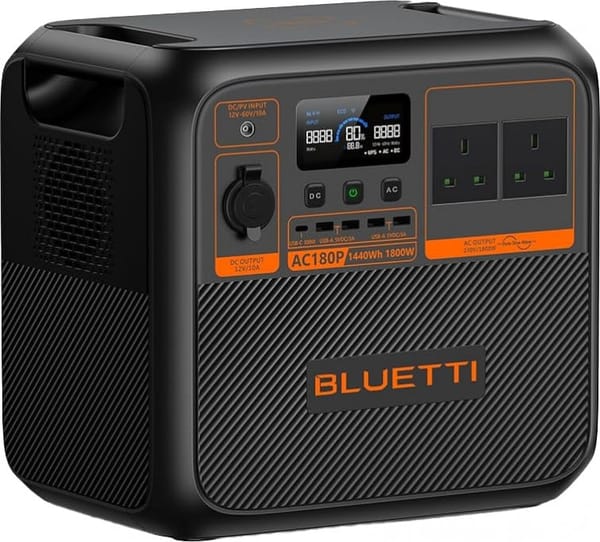
3. BLUETTI AC180P UK Version
BLUETTI AC180P UK Version is intended for backup power in an apartment, office, or during trips out of town. Its power is sufficient for running household appliances and electronics when an off-grid power source is needed without permanent installation.
The station is equipped with UK-style outlets, USB-A and USB-C ports, a car socket, and DC output. It also features wireless charging for compatible devices. It supports charging from the grid and solar panels. A built-in screen displays key operating parameters, and the LiFePO4 battery is designed for long-term use.
Key features:
Backup power for home and office
Solar panel support
Wireless charging
Screen for monitoring operation
LiFePO4 battery
Specifications:
Battery capacity: 1440 Wh
Continuous power: 1800 W
Battery type: LiFePO4
Device connections: AC, USB-A, USB-C, DC, car socket, wireless charging

4. BLUETTI AC240
BLUETTI AC240 is designed for off-grid operation inside or outside the home when stable power is needed for devices of varying power levels. The design supports connecting multiple appliances simultaneously - from electronics to household devices. With its output power, the model is suitable for situations where it's important not only to keep lights and internet running, but also to power more demanding equipment.
The station features multiple AC outlets, USB-A and USB-C ports with fast charging, a dedicated DC output, and a car socket. It supports charging from the grid, car, and solar panels. It includes UPS functionality, a screen for monitoring parameters, and the option to connect an additional battery. It uses a long-cycle-life LiFePO4 battery.
Key features:
Support for multiple devices simultaneously
Charging from grid, car, and solar panels
UPS mode
Screen for parameter monitoring
Option to connect an additional battery
LiFePO4 battery
Specifications:
Battery capacity: 1536 Wh
Continuous power: 2400 W
Battery type: LiFePO4
Device connections: AC, USB-A, USB-C, DC, car socket

5. EcoFlow DELTA Max 1600
EcoFlow DELTA Max 1600 is intended for home backup power and use in areas with limited grid access. Its power capacity supports simultaneous operation of household appliances, electronics, and tools. Suitable for apartments, private houses, or outdoor use where a larger energy reserve is needed.
The unit features AC outlets, USB-A and USB-C ports, DC outputs, and a car socket. It supports connecting an additional battery to increase total capacity. Charging is possible from a wall outlet, car, or solar panels. The station includes a screen for status monitoring and UPS functionality. It uses a Li-Ion NCM lithium-ion battery.
Key features:
Support for household appliances and electronics
Capacity expansion option
Charging from grid, car, and solar panels
UPS mode
Monitoring screen
Specifications:
Battery capacity: 1612 Wh
Continuous power: 2000 W
Battery type: Li-Ion NCM
Device connections: AC, USB-A, USB-C, DC, car socket
How to Choose a Power Station
Buying a power station isn't about "bigger is always better." First, you should understand exactly what you need it for: backup during outages, power for a cottage or trips, or just extra energy for work equipment. The required power, capacity, and connector types directly depend on your needs. It's easier to figure out if you follow these steps.
1. Determine which devices you will connect
Start with a regular list. Refrigerator, boiler, router, laptop, lighting. Each device has its own power consumption. It's important to know not only how many watts one appliance needs, but also whether they will run at the same time.
If you plan to connect equipment with a motor or compressor, account for peak (surge) load. It's significantly higher at startup.
2. Look at continuous power rating
Continuous power is what the station can deliver stably. This is the number you should focus on first. If the station's power is lower than the total load, it will simply shut down.
For an apartment, a mid-range model is usually sufficient. For a private house with lots of equipment, you need some headroom.
3. Pay attention to battery capacity
Capacity shows how long the station can run without recharging. The higher the number, the longer your devices will stay powered.
If the goal is to keep internet and lights on for a few hours, one category will do. If you need to survive long outages - choose a model with a larger energy reserve.
4. Battery type
Today the most common types are LiFePO4 and Li-Ion NCM.
LiFePO4 usually offers more charge cycles and runs cooler. Li-Ion NCM is lighter and more compact. There's no universal answer - it depends on how often you plan to use the station.
5. Ports and number of outputs
Check how many AC outlets are on the unit. If you have several devices at home, one socket won't be enough. USB-A, USB-C, car socket, and sometimes DC outputs are also useful. Don't overpay for features you won't use, but skimping on the number of outlets isn't always smart either.
6. Charging methods
It's great when the station can charge not only from the grid, but also from a car or solar panels. This makes it more versatile - especially if you plan trips or want backup for extended outages.
7. Presence of UPS mode
UPS functionality allows the station to automatically switch to battery power when electricity fails. For computers, servers, or boilers, this is really important - even a brief power interruption can be critical.
Choosing a power station is essentially finding the right balance between power, capacity, and your real needs. Don't focus only on the numbers. It's much more useful to understand which devices need to stay on and how long you want to remain independent.
Conclusion
A 1500 W power station is a balanced solution for home use when you need real backup power, not just an extra battery for gadgets. Its power is usually sufficient for basic appliances and work devices, while the format remains clear and convenient for everyday use.
Choosing in this class is usually based on practicality. It's important to assess which devices will be connected and how long you need off-grid runtime. When you focus on your actual needs rather than maximum specs, picking the right model becomes much easier.